Showing posts with label super car. Show all posts

Wednesday, November 7, 2007

Super car :The Aston Martin DB-ONE


We certainly don't want to be called out for complaining about Aston Martin's current crop of designs. Were we to win the lottery tomorrow, the Aston Martin V8 Vantage would be high up on our list of cars to purchase the day after tomorrow. That said, we've lived with the Aston Martin's corporate style for a few years now, and at some point the next generation needs to be confronted.


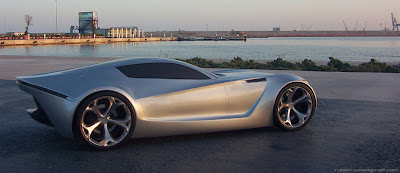
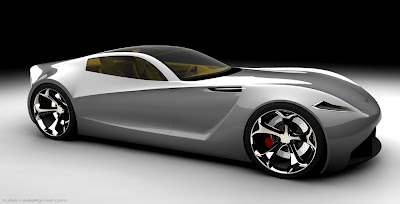
When the time comes, Aston Martin should give this guy a call. Ruben Vela is a Spanish designer who just received his Masters Degree in Automotive Design last year from Polytechnic University in Valencia. He created the DB-ONE Concept you see above (and in the high-res gallery below). Vela says that the design's most important element is "dynamism", kind of a subtle tension between the car's surfaces and lines that gives it an energy even when static. The front grille is much larger than current Aston models and becomes the focal point of the DB-ONE's front end, while the narrow slit headlights ensure that the massive expanse of sheetmetal presents a dominant front end. A true two-seater, the DB-ONE's windshield extends up and over the cockpit to let the sun shine in, as well. The extremely tapered rear is probably the least production feasible element on the car, though it definitely adds to the "static motion" theme.


Bertone headed to U.S. with BMW-powered sportscar?


The blogs are buzzing today about an Automotive News article that reveals Italian coachbuilder Bertone is developing a BMW-powered sports car to sell in the U.S. The article actually focuses on the familial spats occuring within Bertone's management that led to Barbara Bertone, daughter of Lilli Bertone, the company's chairman and CEO, departure in March of 2006. Apparently whatever differences that led to mother and daughter parting professional ways have been worked out, and Barbara has been brought back as the company's managing director. Her sole job is to go out and get Bertone business, as the coachbuilder hasn't had a major job since it stopped producing the Opel/Vauxhall Astra coupe and cabriolet in 2005. Since then it's had some minor work building a special run of 2,000 MINIs, but not enough to prevent the idling of many of its workers.


Of course, the interesting news that caught everyone's eye is this short paragraph at the end of the article that reveals Bertone told its workers it hopes to preserve 300 jobs by producing up to 400 units of a camper van and a BMW-powered sports car for the U.S. market. Automotive News asked BMW about the proposed model, and heard back that the Bavarian boys and girls club was not involved in the car's development, though BMW didn't deny its existence.


Bertone did show a 95th Anniversary Concept at the Geneva Motor Show in March that is based on the Fiat Panda 100HP. This two-seat roadster concept could foreshadow the model referred to in the AN article.


Buick getting fourth model, Velite likely


In an interview with Car and Driver, Troy Clarke, president of GM's North American efforts, confirmed that Buick would be getting another model by the end of the decade. The forth vehicle to join the Buick stable will be rear-wheel drive and take cues from the Velite concept that debuted at the 2004 New York Auto Show.


Whether or not such a vehicle will be a convertible or a large sedan remains to be seen, but it will share the Zeta platform underpinning the upcoming Pontiac G8 and Chevrolet Camaro. The Velite name may not carry over.


In the same article, Clarke espoused Pontiac's goal of being a performance-oriented brand, while at the same time suggesting that all of Pontiac's products will not sport RWD. Clarke confirmed that a redesign of the FWD Vibe is in the works, and may be released as early as this year.


Imports dominate retained-value Top 10... with one exception


We missed it early this month, but the new Power Information Network retained value rankings for the automakers came out, and while the top ten list is pretty much owned by imports, HUMMER crashes the party, coming in at the #8 spot. HUMMER vehicles retain 63% of their original value, an increase of 3.5% over their last showing. Scion sits in the top spot, retaining 69.8%

Toyota (Scion #1, Toyota #5, Lexus #6), Honda (Honda #2, Acura #4) and BMW (MINI #3, BMW #10) actually account for seven of the top ten, with Subaru (7th) and Nissan (9th) rounding out the list along with HUMMER. While domestics remain largely absent from the overall top 10 list this year, they make a strong showing in the top 10 most improved marques in terms of retained value, taking seven of those spots. Click the read link to see the full lists and related statistical information.


Loremo working prototype debuting in Frankfurt


It certainly looks cool, but even fuel mileage in the realm of 117 mpg may not be enough to convince buyers that the nearly totally impractical configuration is worth it. Seriously, a car you have to shimmy over the fender to get into? Think of how much fun that'd be in the winter, especially if you wanted to keep your pant leg clean. Do the Limbo Rock! The concept has nice lines, looking like an update of one of those "car of the future" flights of fancy from the 1950's. Fitting right into that theme is the tilt-away windscreen and controls - again more fun for inclement weather.


Well, that was cathartic. The real news here is that a roadworthy prototype will hit the stand this September in Frankfurt. Details between the showgoing car and actual production models may vary slightly, but the show car will be a very close approximation of what Loremo hopes to offer for sale. One thing that's definitely going to come in for adjustment are the fuel consumption figures. The 117 mpg figure was realized with a computer simulation, so we'd expect that number to change as the prototype goes about proving out all the theory. In addition to the motor show circuit, Loremo will be competing for the California X-Prize in hopes of securing further development funding.


Oldest Caddy in existence going up for auction


How come none of the Cadillacs we've bought for $850 have appreciated to bring millions at auction? First off, this 1903 Cadillac Model A runabout is going to be offered at Bonhams' Quail Lodge auction, part of Monterey Week in August. Our Caddys would've only been appropriate at a scrap metal auction. The 13th ever Cadillac, this car was on the stand at the New York Auto show in 1903, and was the first of the brand to be sold west of the Mississippi.

These brass era Cadillacs are what earned the brand its early tagline of "The Standard Of The World." The "Little Hercules" single-cylinder powerplant sits under the front seat and drives the rear wheels, and the cars were filled with solid engineering. Cadillac made mass-production possible by pioneering interchangeable parts. Nobody thought it was possible to ship a fully-disassembled car to Europe and bolt together a fully-operable automobile from parts that came off the shelf. Cadillac's uniform parts made that stunt possible, and burnished the reputation of the brand in those early days. This car predates that innovation, but if this is indeed the car that was at the New York show, it helped spur 2,000 orders with its precise build quality.


We've not caught wind of any conjecture about the sale price, but old #13 is believed to be the earliest surviving Caddy. Numbers 1-12 have been lost to the sands of time, so this car's unique history and status will likely lead to it trading hands for a considerable amount. Originally selling for $850 back in the day, we wouldn't be shocked to see lots of digits to the left of the decimal. Now, if we could get the same kind of return on that sub-$1000 Cimmaron, we'd be all set.


New Mazda RX-7 On The Way


New MazdaRX-7 is in the works by Mazdaand that Toyotais (finally) beginning to develop an honest-to-God sports car based off the LexusIS platform.


As for the
MazdaRX-7, due to slowing sales of the Mazda RX-8, the engineers at Mazda are hard at work improving the 13B rotary's output. If (when?) the new RX-7 debuts, it will be powered by this new and improved Renesis, supposedly sporting an electrically assisted supercharger, much like the one found on the RX-8 Hybrid that debuted in Tokyo in 2003.

Additionally, the rumored RX-7 will grab styling cues from the Kabura concept (pictured) that was unveiled at Detroit in 2006 and will be built on the platform that underpins the MX-5/RX-8. Whether or not the next gen. 7 will come in a 2+2 configuration remains to be seen, but regardless, don't expect anything until the end of the decade.
Take a review of 1995 Mazda RX-7

The Mazda RX-7 was one of the few classic sports cars to come from Japan. Known for its sleek styling, unique rotary engine and affordable price, the two-door coupe was an instant hit from the moment it was introduced for the 1979 model year.

Mazda's devotion to the Wankel rotary engine is one of the more well-known quirks of the auto industry. Although it is less fuel-efficient than conventional piston engines, the rotary engine has the benefit of being compact and lightweight. These qualities, along with the car's well-tuned chassis and rear-wheel-drive layout, have made the Mazda RX-7 one of the best-handling affordable sports cars ever made.

Through three generations, Mazda made sure that the RX-7 stayed on the cutting edge of design and performance, completely overhauling the car for each model change. Unfortunately, Mazda probably went too far with the final RX-7. Although it was beautiful to look at, the third generation's overall no-compromise performance concept was too extreme, and the car's high price turned off many potential buyers. Sagging sales forced Mazda to stop importing the RX-7 to the North American market just three years into its product cycle.

Though Mazda is currently producing a rotary-powered successor, the four-seat RX-8, many enthusiasts are still hoping the company will bring out an all-new RX-7. Though rumors have floated about, no official plans have been announced.

Mazda's singular goal for the third and final-generation RX-7 was to create a pure sports car. Launched in 1993, this Mazda RX-7 was still a rear-wheel-drive two-door coupe. Available in a single trim, it was powered by a 1.3-liter twin-turbocharged rotary engine that put out 255 horsepower and 217 pound-feet of torque.

The 1993-'95 RX-7 proved to be an impressive all-around performer. It was light, agile and fast. Zero-to-60 times were in the 5-second range. The suspension was tuned for the track, and the RX-7 came with many high-performance features, including a limited-slip differential, four-wheel antilock disc brakes and a five-speed manual transmission. A four-speed automatic was available as an option.

Even though this Mazda RX-7 provided as spirited a drive as anything on the road, it seemed to be too specialized this time around. The suspension was tight, but also too harsh for everyday driving. Mazda didn't offer many luxury options. And with prices in the mid-$30,000s, the RX-7 was also expensive for the time. Sales lagged, and Mazda dropped the coupe from the U.S. market in 1995.

More than a decade later, the last-generation Mazda RX-7 still holds up quite well when compared to more modern sports cars thanks to its exhilarating performance and beautiful styling. Shoppers interested in a used model will want to do plenty of research, however. The twin-turbo rotary's reputation for durability is less than ideal and many RX-7s of this vintage have been driven hard or modified with aftermarket performance parts.

Mazda's intentions with the RX-7 were clear from the very first generation. Sold from 1979-'85, the original RX-7 established the car's DNA as a small, light and fun-to-drive sports coupe. Its 100-hp, 1146cc (1.1-liter) Wankel rotary engine wasn't the most impressive power plant on the market. But a rigid chassis, light curb weight and optimum 50/50 weight distribution gave the RX-7 great handling characteristics. A five-speed manual transmission was standard.

A well-equipped GSL trim was added in 1981, but the first major changes didn't come until the introduction of the GSL-SE trim in 1984. That version replaced the 100-hp engine with a 1.3-liter rotary equipped with fuel injection, producing 135 hp and dropping the coupe's 0-60 time into the high 7s.

Released in 1986, the second-generation Mazda RX-7 was a complete overhaul of the previous model. The 1.3-liter power plant was retained but its output was up to 146 hp. The car had a longer wheelbase and a wider track. And for the first time, it was equipped with an independent rear suspension. Although the car was roughly 150 pounds heavier than the outgoing GSL and had a reputation for being not quite as sharp in terms of handling, it was just as quick. Mazda also offered an optional 2+2 seat layout, but the rear seats were more useful for carrying small cargo than people.

Later that year, Mazda introduced the first RX-7 Turbo, which featured a turbocharged 1.3-liter rotary that made 182 hp. With 0-60-mph time in the low 6-second range, the RX-7 Turbo finally gave the model lineup superior engine performance to go with the car's impressive handling ability.

Capitalizing on the car's popularity, Mazda also released a convertible two-seater in 1988. It was available exclusively with the non-turbo 146-hp engine and a five-speed manual transmission. A year later, Mazda tweaked the rotary engine and bumped the naturally aspirated models up to 160 hp and the Turbo to 200 hp. The convertible was also given the option of a four-speed automatic. After that, the RX-7 remained relatively unchanged until the launch of the third generation in 1993.


Techart GTstreet : The green monster


The first TECHART GTstreet, based on the Porsche 996 Turbo and 996 GT2, has always been a super sportscar which unified these typical TECHART genes.
But for all that, the development process of the new TECHART GTstreet based on the Porsche 997 Turbo started just as it did then: with a blank sheet of paper. In other words, every detail has been newly developed, designed, tested and optimized.

The result of this development has been premiered at the Geneva Motor Show 2007. A TECHART GTstreet which has become even sportier.And which has not inherited any unchanged features from its predecessor but one. Its genes.


The engine delivers 463 kW/630 bhp and 820Nm @ 4,500 tpm. The sprint from 0-100 km/h is made in 3.2 seconds and 0-200 km/h in 10.9 seconds. Top speed: 345 km/h .Enough with the words: enjoy the photos!

PRESS RELEASE: With its 2001 TechArt GTstreet based on the Porsche 911 Turbo of the 996 model series, TechArt Automobildesign created one of the fastest and most powerful street-legal sports cars of its time. The next evolutionary stage of this fascinating concept celebrates is now available: The new TechArt GTstreet, based on the 911 Turbo of the latest 997 series, starts at 245,000 Euros MSRP.

Like the predecessor the new GTstreet edition centers on a powerful engine: The 3.6-liter twin-turbo flat engine is modified by the TechArt engine specialists and now develops 630 hp / 463 kW at 6,800 rpm, up from standard 480 hp / 353 kW. Peak torque increases from 620 Nm to 820 Nm at 4,500 rpm.


The TechArt TA 097/T3 engine conversion comprises two special VTG turbochargers, a new air box with sport air filter, high-performance manifolds, intercoolers and a stainless-steel sport exhaust system with high-performance catalysts. The precise optimal interaction of all modifications is ensured by a newly programmed engine management system.


Power is transferred to all four wheels via a modified transmission with TechArt gear-throw shortening. Thus equipped the TechArt GTstreet delivers performance that firmly places it among the world's fastest sports cars: 0 - 100 km/h in just 3.2 seconds, 200 km/h after just 10.9 seconds and a top speed of 345 km/h speak volumes.


The body kit for the TechArt GTstreet was created in the wind tunnel, and offers an optimal symbiosis of aerodynamic downforce, minimized drag and striking design. The front fascia of the GTstreet with retractable carbon-fiber splitter produces downforce on the front axle and provides radiator, oil coolers and brakes with more cooling air, thanks to its large, striking air inlets. The auxiliary headlamp units with daytime running lights and fog lamps improve active safety. They also give the car even more passing clout.


The TechArt GTstreet fender flares on the front axle add 10 mm to the two-door's width and give it an even more dynamic appearance. But that's not all: The air outlets behind the front wheel houses optimize brake venting. The larger air ducts in the rear sidewalls provide engine and intercoolers with a larger supply of cooling air. For an optimal transition between front and rear fenders the TechArt designers have developed rocker panels that complement the new contours. TechArt mirror and headlamp moldings provide the finishing touches.


The TechArt roof spoiler extends the roofline and optimizes airflow to the adjustable rear airfoil of the GTstreet. The TechArt GTstreet rear fascia with integrated carbon-fiber diffuser contributes to the strong downforce generated on the rear axle. It also provides the perfect backdrop for the quad exhaust of the TechArt high-performance exhaust system.


TechArt Automobildesign offers a number of versions of its popular Formula wheel in sizes 8.5Jx20 in front and 12Jx20 on the rear axle. GTstreet buyers can choose from several color combinations and between the one-piece Formula and the multi-piece Formula II designs. The Formula II wheel features an exchangeable wheel lip. For optimal tires TechArt chose ContiSportContact 3 high-performance tires in sizes 245/30 ZR 20 and 325/25 ZR 20.


The large 20-inch wheels also provide the necessary space for the especially powerful and durable TechArt high-performance brake system. It features six-piston aluminum fixed calipers and 390-millimeter discs on the front axle. The rear axle is fitted with 365-millimeter discs and four-piston fixed calipers.


The TechArt GTstreet comes with a TechArt VarioPlus coil-over suspension that is based on the electronically adjustable PASM damping system of the 911 Turbo. This chassis allows individual ride-height lowering by up to 25 millimeters and push-button selection of two different damper settings, "Normal" or "Sport." However, the dampers are not limited to these presets. Sporty driving automatically results in firmer damper settings in both modes, thus combining excellent ride comfort during normal driving with agile and responsive handling during fast cornering.


The cockpit of the TechArt GTstreet also differs distinctly from the stock 911 Turbo. Among the differences is an exclusive leather interior with color-contrasted stitching and sporty CarboBlack highlights. The coupe is further equipped with an ergonomically shaped TechArt sport steering wheel, aluminum foot pedals, foot rest and shifter, as well as with illuminated door sills sporting the TechArt logo.


Blog Archive